Showing posts with label introspection. Show all posts

Sunday, July 29, 2012

Adventures In Tarot

Haven't talked about Tarot in a little while, and I thought it might be nice to do so in an actually in-depth way. I just recently came into possession of two new decks: Marie White's Mary-El Tarot and Barbara Moore's Steampunk Tarot. The latter is exactly as goofy and awesome as it sounds, and I actually like it a great deal. It's very indebted to the classic RWS Tarot, making it the most straight-forward deck I've ever owned, so it's nice to do simple readings for a change. Mary-El, meanwhile, is the most breathtaking visual experience I've had yet in Tarot; the cards are gorgeous, each one originally done as an oil painting by Marie White. But it's very very difficult to read, largely because Marie White goes into intense and often flowery descriptions of the veritable clusterfuck of mythological context she put into each and every card - which is FASCINATING, but also makes for an unusually inaccessible deck. It's hard to know what the heck she's talking about sometimes, and what her cards are supposed to mean. She's basically worked out a whole new hierarchy of meanings, blending RWS with the Thoth deck and pulling from just about every spiritual system known to man. I was beginning to get a little frustrated with how hard it was to make heads or tails of her cards, so I decided there was only one way to deal with it, and that was to design my own spread.

I've designed a Tarot spread before, though I've never put anything about it online - it's huge and complex, and I only use it when I need to bring out the big guns. Today I made a much simpler spread, and I like it pretty well, and I decided to share it. I'm calling it, somewhat unimaginatively, the Spiral Spread.

Here is a numbered picture of a trial-run I did with Mary-El, so you can see the layout. Position meanings below.


The positions, which, considering this is a brand new spread, as subject to future adjustments:

1. The Querent's Chief Desire or Problem
2. Other Factors (details needed to understand the situation)
3. Hopes and Fears
4. A Lesson Learned
5. An Obstacle
6. Advice
7. Action
8. The Bridge (what to bear in mind)
9. Outcome

The thing about spreads is, anyone can make them! You just have to know what it is you want to learn from a spread, without getting too specific or crazy. Tarot works best as a nudge in the right direction or just a way to get yourself thinking outside the box, it's not a step-by-step guide to life. I make my own spreads sometimes because I get tired of the traditional layouts, but I've still drawn from position meanings I've seen in various spreads. I just combined them in a different way, which I like better. Let me take you through the positions briefly:

1. Desire/Problem - Pretty straight-forward - this card represents the main question being asked, or the issues at play. It's was the querent most wants, or is having the biggest trouble with.

2. Other Factors - A supplement to position 1, meant to offer further information about the situation, maybe something infuencing the querent or the circumstances.

3. Hopes/Fears - This is a basic traditional position which you'll find in many spreads. The querent's hopes or fears for the future with regard to the situation. Pretty simple, pretty important.

4. A Lesson Learned - This is a thing I've never yet encountered in an existing spread, but I like it. It is meant to represent either something the querent has learned or experienced in the course of their problem, or which they need to learn to get through it. Or I'm sure there's another way to look at it - it's open to interpretation.

5. An Obstacle - Another basic position, it's something keeping the querent from achieving goals or solving problems. 4 and 5 might work in conjunction just like 1 and 2 do - 4 might be the tools needed to overcome the obstacle.

6. Advice - Exactly like it sounds! One of the tricks with this kind of position, I have found, is that you don't always get a good, positive, advice-sounding card. What if you get a really negative card in this position? WELL, don't worry: I usually look at that kind of thing as a reminder to stay vigilant, and not let those negative influences overpower me.

7. Action - A lot of spreads are missing this position, which I think is a pretty important position! I don't want my spreads to be 100% passive observation. I like getting a good shove, too. The action you take, or shouldn't take, of course.

8. The Bridge - This is my favorite position of the spread. I was having trouble getting the design to look suitably like a spiral, when I experimented with turning this card on its side, and it just immediately made sense. This is a bridge connecting 7 and 9, the Action and the Outcome. It isn't always so easy as just doing a thing and then getting a result. You have to remember what you've learned, for example the information from positions 4 and 6. That's what this card is for. This spread has a lot of emphasis on learning lessons and being knowledgeable about what's going on inside your head, and I think that's the most important thing when you're asking for guidance. My hope is that the spread serves to help the reader collect his/her/zir/etc thoughts about the reigning issue, and helps give a little courage if the times are tough. A firm pat on the back or a swift kick in the rear, whichever is appropriate.

9. Outcome - The basic final card of any spread, where you'll be if you continue on the path or alter things as directed. Again: if you get a negative card in this position, I would think of it as a challenge to change that outcome.

So, now let's look at what I got. I wasn't asking a particular question, and it wasn't about me personally - because Mary-El is so heavily steeped in mythology, I decided to look for something I could use to develop the future plot of my novel, Berlin Confidential.


Marie White talks a lot about the collective unconscious with this card, and how her impressions of the Cups suit has shifted from being strictly about relationships to being more about humanity as a whole, which I think is PRETTY INTERESTING, if difficult to apply to one's personal life. You see what I mean? She is very concerned with big sweeping statements and not so much about relating each card to the reader on a personal level. But that's why I'm approaching this from a big mythy perspective. If we look at this spread as having to do with my novel, then yes, a definite Big Issue of the story is the nature of humanity and the way cultural attitudes shift and change. So: an appropriate card for position one.


For the Knight of Disks, we get a story about Siddhartha, growing up sheltered, then being horrified to learn the dirty truth of the world. In this deck more than in any other I've seen, "Disks" are incredibly earthy, concerned with the physical aspects of the world and the universe. As I see it, it can only be about Herr Inspektor, the protagonist of the novel, an ordinary man who is very sheltered in that he believes life and the world to be orderly and simple, until he is confronted by the horrors of this other world, the world of demons and monsters and murderous beasts. It's especially appropriate given the Buddhist background for this card, since Herr Inspektor is very much a middle-of-the-road character, trying to find a solution without going too hard to one extreme or the other.


It's funny - when I saw this card online before buying this deck, I wasn't sure how I felt about it. I thought it was super weird, having a big ol' baboon for the 9 of Cups. But I'm starting to love it. Marie White talks about the baboon as being an aspect of Thoth, who is apparently often represented by a baboon, so-! (someone needs to bone up on her Egyptian mythology). Without going into too much crazy mythology detail, Thoth was basically one of the gods balancing the universe, the other being his wife Ma'at (WHO, interestingly, we also see in this spread) - he seems to have been largely concerned with science, magic, arts, judgment of the dead and being an arbiter between good and evil. She also talks about being in awe of the universe, being able to accept your place within it. That sounds again very Herr Inspektory, and something he struggles with maybe more than anything. So yeah. Onward!


One of faaaaavorite cards, and one of the reasons I decided to get this deck, because LOOK AT IT. The Sun is about exaltation, total self-realization, and unfettered joy. Marie White talks about its place at the conclusion of the Fool's journey (and Herr Inspektor is, of course, our Fool), that he goes through all the experiences of the Major Arcana and comes out with fully realized potential. Difficult to determine what it means here, in this position. It's such a big, final thing for being a lesson that has been learned or needs to be learned - and of course our hero is not very Sunlike! Curious. I shall ruminate.


Here's Ma'at, Thoth's wife. Ma'at is all about the LAW and yes, justice, which is funny because that is exactly what Herr Inspektor is all about. We could see that as an obstacle in that his stubbornness about doing things the "right" way, obeying the sense of order that he knows, is not working out for him, and sort of blinding him to the reality of the situation. This actually could interact with The Sun in an interesting way, like by being so bound to his principles he is not embracing the fullness of his potential. The Sun could also reflect the impact of certain other characters on him. To say more would be to go into too much detail for people who have not been reading, though.


There is an EGREGIOUS grammatical error in the description for this one, and what's worse is it's NOT THE ONLY ONE. I have found several already, and they are all egregious, middle-school-level errors. Here she uses "you're" instead of "your." I am forced to conclude she didn't have an editor for this book, and if she did, SOMEONE DROPPED THE BALL BIG TIME. That along with the general inaccessibility of her interpretations makes it very hard for me to get into this deck, which is a real shame because it's gorgeous and I want it to be my deck forever. BUT ANYWAY.

For this card she talks about Muninn of Odin's two ravens, the one representing Memory. She goes on a big ramble that I can't make heads or tails of, stuff about realizing your potential (a lot of these are about similar huge themes and concepts, which is a problem when you're actually trying to divine distinct meanings from them!), which isn't important because MUNINN, GUYS. For the BC-initiated, Muninn, coupled with the "advice" positioning of this card, is really all you need to know.


This one is interesting. She talks a lot about different Archangels, which is a bit of a yawnfest for me, but the overarching message is one about spiritual guidance and building bridges/connections. Which is .... super weird considering this is the card that leads to the Bridge. Traditionally, Six of Swords is a travel card. Both these meanings - physical and metaphysical travel - are incredibly apt in terms of "action" for basically every character in BC.


Here we have a lamb caught between two lions. Marie White talks about judgment, the path to immortality, balance, self-sacrifice and martyrdom. This is basically perfect in every way.


Marie White is obsessed with relating Wands to sex. I've read so many of them and she just talks about lust and libido and sexual energy. To which I say, all right, but I need more, you need to be more specific, or what is to distinguish between 3 and 4 and all the other Wands? Hmm? Fortunately, I have something to add: for me, the Four of Wands has always represented freedom/escape/transformation, which isn't exactly traditional, but it's the meaning I got from Archeon and it's a meaning I've liked and kept. And I'm keeping it here.

And there you have it. If any curiosity has been aroused, Berlin Confidential is currently on hiatus, which means now would be a grand time to start getting caught up. It's long, but I'd like to think it's worth it.

Sunday, July 22, 2012

Fuck The Empire & Other Thoughts About Hollywood

After having a regretful ten minute Netflix experience, I tweeted some thoughts off the cuff and after the fifth one decided to turn those thoughts into a post.

I became really interested in movies when I was thirteen, largely due to the influence of my dad, who was becoming a real movie buff around that time. As the next several years passed, he started working through a lot of old, well-regarded classics, and I grew gradually more willing to see things outside my comfort zone (which was SO NARROW at thirteen, oh my gosh) until we were watching a lot of movies all the time. I discovered new things, like how to identify a 1960s movie by the quality of the film and that Audrey Hepburn is in many ways the best. Eventually we decided to watch the very highly-regarded Hepburn machine Breakfast At Tiffany's, about which we knew very little. I distinctly recall starting it one night and then crapping out very early in the game, though I could not for the life of me remember why. I have come to assume that we became bored and just quit, which was always sort of strange to me, since we surely hadn't given it enough of a chance? That isn't like us.

So now, years later, someone recommends that I give Tiffany's another shot, and I see it's on Netlflix instant, so I started it up again full of open mind. Minutes later, I quit again, probably at the same spot, and I'll TELL YOU WHY. What I had forgotten is that an aged Mickey Rooney appears very early in the movie as "Mr. Yunioshi," Audrey's cranky upstairs neighbor, one of the most disgustingly stereotyped caricatures of a Japanese person I have ever been confronted with. Because you know, Old Hollywood was always casting white people as comedic Asian characters. And here's a thing: I've put up with that before, PLENTY of times. Peter Sellers in Murder By Death, various Monty Python sketches, the appearances in countless old movies that are small and upsetting but easy to brush aside. Sometimes it's played for laughs, and sometimes, ashamedly enough, it makes me laugh, often while peeking through my fingers like oh god, what am I watching.

There's nothing really more offensive about Mickey Rooney's performance than Peter Sellers or Graham Chapman, but somehow this time it was just NOPE. Fuck you, movie. I had a moment where I thought about just pushing it aside, that old justification, "oh it's just Old Hollywood, that's what they did, movies can still be great in spite of the social atrocities of the classic era" - but no! FUCK that noise. I don't want to sit through racist stereotypes that have no purpose other than cheap laughs, and I don't HAVE to! This may not seem very radical, but it depends on your perspective. My approach to movies has always been bound up with a lot of obligation: I appreciate good cinema and I want to make movies, so this is part of my history and art education, and I have to see as many old greats as I can fit into my life. I think a lot of people feel this way. Forgive Hollywood's transgressions because this movie is still a game-changer, a paradigm shifter. But you know what, no matter how much of a movie buff you are, how important movies are to you - there's still places where you can draw a line, and you MUST draw a line. We forgive Hollywood's bullshit all the time. Exercise your right not to forgive.

I remember being basically forced to sit through Birth of a Nation in a college film history class, and that movie had me shaking and crying by the end with how disgusting and horrible it was. Fuck the system that lets us forgive that fucker because it was the First Feature Film, because it did things with the camera that no other movie had done at that time. Fuck D.W. Griffiths. Someone else would have come up with that shit without him, and they probably wouldn't have had to glorify the KKK while doing it.

We can't pretend the various awful chapters in our history didn't happen, and that there isn't still a huge amount of hurt from it, from the insane culturally ingrained racism that led us to things like Birth of a Nation and Mickey Rooney's role in Breakfast At Tiffany's. Those things still stick in us like needles. But let's be crazy for a second: let's say we don't forgive that shit. Let's say we stop with the "it was a different time" bullshit, and if something makes you uncomfortable or angry, don't fucking watch it. I am definitely not the first person to come to this conclusion, but it's probably a point that can never be made too many times.

Breakfast At Tiffany's had its chance, twice. Moving on to something that managed to be old without being gleefully hateful.

Tuesday, April 24, 2012

Dealing With Melancholia

I wasn't going to write a post about Melancholia, but after getting briefly involved in a discussion about it with Zac Little (blogger, youtube rebel & enemy of bad journalism), I suddenly realized I had a lot of things to say. Or a few things to talk about at length. Either way, this is long and this is personal. Fair warning.

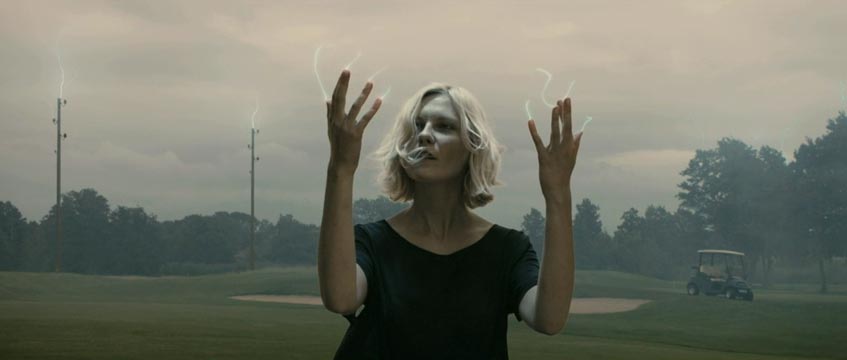
For those of you not familiar, Melancholia is a film by Lars von Trier, who describes it as a psychological disaster drama, wherein a rogue planet (called Melancholia, duh) is drifting through space and is supposedly going to pass gloriously and harmlessly by the Earth, but in fact rams into us head on and destroys everyone and everything including our main characters, Kirsten Dunst, her sister Charlotte Gainsbourg, and the latter's young son. It may sound like I just spoiled the ending for you, but it turns out I did not! That information is all contained within not only trailers, but the opening eight minutes of the movie. Von Trier has said that he did not intend for any suspense related to whether the Earth will be destroyed, but rather in how the characters react to the knowledge.

Spoilers and greater details regarding the rest of the film and my complex hurricane of feelings about it after the jump.


I should start off by saying that I went into this with an intense dislike of Lars von Trier. I have a lot of reasons for this, which I'm not going to go into, because that's not the point, and ultimately it doesn't impact my ability to enjoy [THIS ONE PARTICULAR EXAMPLE OF] his work. I find that one is quite capable of deeply hating various people and begrudgingly respecting them at the same time (Quentin Tarantino, Roman Polanski, Ron Burgundy), and since those are really two different conversations, I am not going to defend or explain my feelings about Mr. von Trier right now.

Those feelings did, however, keep me from seeing Melancholia in the theaters, which is a bit of a shame, because damn if this is not a movie that should be seen as on big a screen as possible. But I watched it on Netflix, about a week ago, and I have been in recovery ever since.

Melancholia is part of a current trend toward End Of The World movies. Has anyone else noticed this? In addition to Melancholia there's been Contagion, a thing with Eva Green and Ewan McGregor which looks like it is just full of emotional whiplash, and an upcoming similar thing with Steve Carell and Keira Knightley. More recently there was ALSO Another Earth, which is not about the end of the world at all, but IS about a mysterious and unexplainable cosmic event and how it psychologically impacts its main characters, which is extremely similar to Melancholia. (Though quite different in scope, focus and budget, Another Earth is also mightily worth seeing.)

This is not to say that we've never made end-of-the-world movies before, certainly we have. But I'm starting to sense a change in direction. Lately filmmakers seem to be trying to go hyperrealistic with it, or to focus less on the destruction and the action elements that are traditionally paired with such movies, and focusing more on the psychological effects, the human stories at the core. Which is good and more interesting to me! But it also annoys me for an incredibly petty reason, which I'll tell you briefly even though it is off topic: before all of this started, I had a vivid dream wherein I knew the world was coming to end through some unstoppable cosmic event, and we had known it was coming for a number of years, and this was the last day. Waking up was an intense relief that I have never quite felt before. All that dread and anguish my subconscious made me feel was very real, so I took the next natural step and started writing a story about it, to get those feelings on paper. I never finished the story, and within some months these movies started cropping up, and now what may have been a somewhat original idea looks like it's following a trend. This has been happening throughout my life and fuels me in my belief that I must get things done NOW NOW NOW or it will be too late because someone will unwittingly steal it from me, which in turn feeds into my obsessive perfectionism that makes everything very difficult for me. But more on that in another post, perhaps.

I'm not going to talk a whole lot about my interpretation of this movie or the artistry of it, because I think a lot of other people are probably talking about that better than I can, and what I want to talk about is in keeping with the general theme of this blog, which is about the depression, panic and fear that is depicted in this film, and also incited by it. As such you probably shouldn't look at this as a review. This is personal, a disjointed commentary on how this movie affected me.

The first eight minutes of the movie are cut off from the rest, and could almost be watched separately as a short art film. It depicts Dunst and Gainsbourg in a variety of surreal scenarios as the world comes to an end around them, all shot in super slow motion so it's sort of agonizing to watch, for more reasons than one. During this period you learn something about both of them: Dunst is grim-faced, unafraid, fascinated by what is happening around her. Gainsbourg is fucking terrified.

There's a particular shot which was used in the trailer and haunted me then, and haunts me now: Gainsbourg running (well, in the motion of running) across a golf course, carrying her son. It looks like she's screaming or crying (there is no sound in this sequence, just a relentless clip of Wagner music which recurs endlessly throughout). The thing that gets me about this shot is her footprints. They're pronounced, muddy -- it's hard to tell, but it looks like they're deeper than they should be. Is this supposed to be an effect of gravity caused by one planet hitting another? I don't understand enough about physics/astronomy to know, and I'm quite certain that von Trier didn't really research shit like that, because it wasn't important to the story (I get that, I do). In any case, her positioning is odd, there's almost an uncanny valley look and feel to this whole sequence, how abominably slowly everyone is moving, and let me tell you: it fucking terrifies me. Once you watch that sequence I sort of defy you not to watch the rest of the film, but I also understand if your reaction is "FUCK no" at that point. I sort of doubt you'll follow through -- well, unless the "fuck no" is a response to the high-artistry of it, and that kind of stuff just turns you off. I'm talking about the deep stomach-turning dread of this scenario, world ending, nowhere to run but running anyway. I feel like the slow motion is almost meant to give us a sense of helplessness -- they're not going anywhere, there's no time to do anything, this is happening. And maybe it's also meant to show us some calm (those are definitely the conflicting responses of Gainsbourg and Dunst, respectively). In any case, it's beautiful and grotesque, and at the end of it this giant planet hits our little one head-on and that's the END OF THAT. Then the movie starts.

That sequence is supposed to be viewed like the overture to an opera (of course the Wagner music is FROM the overture to Tristan and Isolde): setting up visual motifs and sort of introducing the characters and telling us the ending, so we know what's coming and we know the significance (or lack thereof) of all actions that follow. Then the movie starts.

The film is divided into two parts, each focusing on the two sisters: Justine (Dunst) and Claire (Gainsbourg). The first half is mostly about Justine's unbearably awkward wedding going horribly, quietly awry -- she becomes increasingly depressed and withdrawn, the ceremony goes hours and hours over schedule, tensions are high, etc, finally leading to Justine having sex with some stranger and her husband the vampire from True Blood calling it off just as soon as it's over. WELP. There's some stray focus on the night sky throughout this sequence, lots of fancy telescopes in the background of shots, lots of Dunst gazing up at the stars, and it's sort of maddening because the viewer knows what's coming and is forced to wait it out, instead watching this dreadful occasion fall apart. There's a lot to be said about this, but I'll leave that to someone else. I want to talk about the second half.

In the second half, Claire and her husband Kiefer Sutherland (I know, right) are receiving Justine at their estate, where the wedding took place -- so time has passed, but we haven't moved. Justine is now in a state of severe depression. The kind where you can't get into a taxi cab that's waiting for you because you're too scared to go anywhere. Where you don't get out of bed for literal days. Where you won't even take a bath, even that is too hard, even when your sister has undressed you and is trying to help you into it.

I have never had those three experiences, but holy fuck, I have been there. I know what that is. I know what it is to revert to this sort of childish state of being because you're too afraid, too ill-equipped to face your life. I know that fetal position, that limpness, that scream, that way of sort of drifting through the day. I expect that everyone who knows these things suffers the same pangs of shame and embarrassment at seeing this accurate depiction of emotional turmoil, and I know that Lars von Trier was drawing from personal experience. If you have ever been seriously depressed to the point of incapacity this is going to hit you. Even if you haven't been THAT seriously depressed, it'll hit. If you're already depressed on the day that you decide to watch this movie (as I was), it is going to drag you down further. Not least because of where it's headed.

Justine starts to recover bit by bit, and the focus shifts to Claire. Her husband (Jack? Joe? John? I don't remember, I just know I hated him) is an amateur astronomer and he is very excited about this exciting phenomenon of the planet Melancholia drifting by. Claire, a sane human, is not really excited and more obsessively googling to see if they're going to be all right. Which of course annoys unsympathetic control-freak husband Sutherland to no end. EVERYTHING WILL BE FINE, Claire. YOU JUST LISTEN TO ME, EVERYTHING WILL BE FINE.

Obviously, we know he's wrong. Everything is not fine.

I hate him, and I think you're supposed to hate him, for a few reasons. This everything-will-be-fine attitude extends to his having no patience for Justine's depression, which, fuck you, man, seriously, fuck you. He shows himself again and again to be nothing but a greedy rich husband who likes being in control of his wife, her sister, everything around him. And NATURALLY, because there is no other ending for a guy like that, when he learns he is wrong after all, and that his doom is coming and there is nothing he, even he, this control freak, can do -- he kills himself. He kills himself with pills CLAIRE BOUGHT, possibly to kill herself with. He doesn't say anything to her. He doesn't tell her the truth about what's happening. He just vanishes, leaving her to discover the truth on her own, and to find his fucking body in the stables. GOOD JOB, ASSHOLE. I mean, it's a perfect ending to his arc, but oh my god do I hate him. I hate him for not being there for Claire. Because oh my god, if Justine was me before, it's nothing compared to how much Claire is me. I can't deal with how much Claire is me. Literally, I'm not saying that like they say "I can't deal" on the internet... I actually, earnestly can't really deal with it. It upsets me. It upsets me how true her reaction to oncoming inescapable destruction feels. I am sure it's a reaction many people could expect of themselves in such an event, but that doesn't matter, if you've ever felt down on yourself you know it doesn't matter that others feel the same, are going through the same hardships. Not really. The viewing experience is personal, intentionally so. I watched it and didn't see Claire as a representation of a greater portion of humanity: I saw her as me. I am a coward. I would run. There is nowhere to run but I'd run. I'd want to attempt to do something meaningful or comforting with my last hours (as she tries to suggest, an idea brutally shot down by the now totally zen Justine), even if it's stupid and won't help. I'd cry and scream and refuse to accept it down to the last minute. Maybe that isn't true, maybe I'd react differently. But I don't think so.

I don't really like that about me.

On Wikipedia it says Lars von Trier came up with this idea after talking to a therapist about his depression -- evidently she told him that depressed people react calmly to great disaster because they already expect the worst. Makes sense, I guess. Justine reacts with total calm, even happy to know that the world is ending, that humanity is about to be snuffed out, because fuck humanity. Which is a pretty disturbing sentiment. Also disturbing is her seemingly clairvoyant assertion that they are alone in the universe and this marks the end of life AS WE KNOW IT. We're sort of given to believe that this is in fact true, that Justine has some sort of power that allows her to know things. I think Lars von Trier probably wants us to believe her. I don't entirely know why this was so important to him, that this marked not just the ending of humanity but of all life. Actually I guess I do know: because of the finality. The emptiness of the black screen that comes when the planet is finally destroyed. That is it. There is no hope. There is no reassurance. That's just it.

Afterward I called this movie the ultimate nihilist experience. It is almost masturbatory in its nihilism. And it made me angry that I had watched it. It made me angry that Lars von Trier had evoked all these fears and feelings in me, angry even while I recognized that he had done his job as the filmmaker, and that any movie that affects you that way is worth your attention. But still it made me angry. That's about me, not so much about the movie. About me desperately afraid that I'm going to die young, or that the world will end somehow, or that one day things will get so bad that I'll be too afraid to get out of bed. This movie showed me all the worst things about myself. Justine's drift into darkness that keeps her from enjoying her own wedding. Kiefer Sutherland wanting to be in control of his life to the degree that when he sees the inevitable hurtling toward him he pussies out and takes pills. I see both of those in me (that's why I hate him so much). Mostly there's Claire, though. Wanting it to be a bad dream, like the bad dream I did have, wherein I behaved more or less like I expected. I don't want to be that person, I don't want to be Claire. But I am. I'm Claire.

I guess that's sort of all I have to say, and it's abrupt, but that's kind of fitting in a post about this movie, isn't it?

Wednesday, April 11, 2012

Meditations in a Rational Moment

That last post was a doozy, and while I think I needed to get that it off my chest, I didn't like having it sit up there at the top. Time to cheer up. Time to move on.

First things first: I know a lot of people found that last post by searching the depression tag on Tumblr, which, if you've ever done that (TRIGGER WARNING), you'll know is about the most devastating thing you can do. If you've been led to this post in the same way, then I hope you read this too: I know that when things seem hopeless, it's hard for someone to make you magically feel better - there's no switch to get flipped, there's no way to just force yourself back into a happy mood. Know that these things take time, life will not always seem awful, and there's no sense in punishing yourself for what you perceive as your shortcomings. Just saying that doesn't make much of a difference, I know; but knowing it intellectually, just telling yourself that you don't deserve the sadness or the pain, even if you don't believe it at first, is an important first step. Take note of your emotional state, and don't do things to yourself or make big decisions when you're not doing well or thinking rationally. Everything seems so much worse and more apocalyptically bad when you're upset. Take it from me, in a rational moment: a good period will always turn into a bad one, and a bad period will always turn back into a good one. You gotta learn to ride the wave of your emotions, to use a slightly ridiculous but apt metaphor. And talk to people. Find people who will listen to you. Call a hotline if you don't know anyone who will listen. Get it out of you. Don't feed it into the unsatisfying echo chamber of your Tumblr. Channel it into something productive (wash the dishes, clean, go for a walk) or creative (write stories, draw pictures, make music). Or put it somewhere where you'll hear something back.

As for me, my life is moving along at a better pace already. Sometimes it takes that incredible despair to get you up out of the pits, moving again, whether to spite yourself for feeling so low, or just because ENOUGH already. That's been my experience, anyway.


So the prospect of living life is a lot closer, and that's still moderately terrifying, but as pieces fall into place I feel more or less okay about it. It's easier to move when you already have momentum, it's starting to move that is terrible. And the waiting. The long, awful period of waiting and wondering what's going to happen in my life. Maybe that feeling never fully goes away. Maybe it's something you just have to live with. Sometimes you have to live with your sadness. And that's okay.

Today's Rilke reading is wonderfully apt. From Letters to a Young Poet, which is required reading for every aspiring writer/artist:

It seems to me that all our sadnesses are moments of tension that we
feel as paralysis because we can no longer experience our banished
feelings. Because we are alone with the unfamiliar presence that has
entered us, because we feel momentarily abandoned by what we've
believed and grown accustomed to; because we can't keep standing
as the ground shifts under our feet. That is why the sadness passes
over like a wave. The new presence inside us, that which has come to
us, has entered our heart, has found its way to its innermost chamber,
and is no longer even there—it is already in our blood. And we don't
know what it was. We could easily be persuaded that nothing
happened, and yet something has changed inside us, as a house changes
when a guest comes into it. We cannot say who has entered, we may
never know, but there are many indications that the future enters us
in just this way, to transform itself within us long before it happens.
That is why it is so important to be alone and attentive when you are
sad: because the seemingly uneventful and motionless moment when
our future steps into us is so much closer to life than any loud and
accidental point of time which occurs, as it were, from the outside.

Saturday, April 7, 2012

Deprecation

When you were a kid you were going to be somebody. A household name, a world-changer, a paradigm shifter. Big deal. Kids think this of themselves. Kids of your demographic are raised to believe they have it all and can be anything they want. Everyone has heard the same tired arguments that children should not be raised to believe they are special, should not be sheltered to the point of grand disillusion when they get out there in the horrible world, but that doesn't really matter to you right now. Those arguments are systemic and do not reflect your individual situation. Your parents did not spoil you, did their best to prepare you, which is all any parents can ever do. They encouraged you to get a job, and when that did not work, when reason failed, they begged you or fought with you. No small successes made much of a difference in the long run, and that is okay. You know that is okay and you've come to terms with it. You were a kid; you had no idea it would be this rough.

When you were in college you were going to be somebody. You were on your damn way. Making movies, writing stories, surrounded by the like-minded, the strong-willed, the ambitious and the clever. It was never a paradise but you loved it, even on sad days you berated yourself for wasting your incredible good fortune on being sad, and in moments of great happiness you took care to look at your surroundings, to reflect on yourself, to remind yourself that very soon this will all be gone, and you made sure to remember. You have these moments logged away, collecting dust, already hazy, so little time later.

You were a force to be reckoned with there, a small reputation gathered among your peers and certain of your professors for being wildly engaged and perhaps psychotically productive (while others noted that your work for their classes was slipping gradually to the wayside; but those classes did not matter, they were filled time, necessary credits, bare essentials of academic life, small concerns because you were making things). When it came time to leave, you were ready for it to be over (they always are) and you had plans - nothing concrete, mind - to continue on this path to greatness and glory, no matter what it took, no matter where you were. Your mentor advised you not to go back home, to stay here, in the city, where everything was happening, but you could not do this, for personal reasons and practical ones. This too is okay. You did nothing wrong. You had no idea it would be this rough.

For three months and then for one year you lived with friends and then with family, happy and unhappy, busy and not. After five months you got a job. After two months they fired you: you did not work hard enough, did not excel quickly enough. They fired you right before Christmas, just after you finished your shopping, after you decided to spend more than usual on your family because hell, they deserve it, and look at you, actually making money! Mistakes were made; but you couldn't have known they'd fire you. Fuck them, anyway. It was a restaurant. You do not belong in restaurants, with your weak limbs and your quickly-tiring feet and your soft voice and your awkward, easily overwhelmed nature. It does not matter. You will find something else. Hell, you will start that novel you always wanted to start. You can put it online to share with anyone who will read it, to keep things moving, to get into a rhythm. You're going places. Some days you have to struggle to persist, and sometimes you let it all slide away. At the back of your mind you know you've got to take the rest of your life off hold; but you'll be fine. Someday you'll figure it out; someday you'll know. Something is bound to turn up.

And then gradually you realize that you don't want the same things you did a year ago; you don't know where you want to live or what you want to be doing, and, aghast, you mourn for the loss of that kid, that student, that wild thing who could be anything she wanted. What has happened to you? You've become thick and lazy and bent out of shape. When those rare occasions do come for you to make things again, you barely remember how; it is something like riding a bike, but just as you always were with bikes, you are clumsy, you forget how to operate your camera, must relearn all your tricks. You realize, with a slow onset of deep internal fear, that you are getting worse, bit by bit, that if this continues you may lose yourself entirely. Your friends barely think of you anymore, and why should they? They are far away, living lives no easier than yours, but perhaps more active, more surrounded by others, even if they do not realize it and do not take advantage of that fact. Occasionally you visit them, but it grows harder every time, and more and more you find reasons to back out of it: lack of money, lack of incentive, lack of floors to sleep on. This is becoming a habit for you, isn't it? This "who are you kidding" mentality. You're not qualified for that job. You don't have the money for that visit. You aren't good enough to write that story.

And it's almost two years now, almost two whole years, and who are you? What happened to that kid, that student, that wild thing? What have you got to show for yourself? A thousand unfinished projects and that novel, still going strong, it has its ups and downs and no one is paying you and hardly anyone is reading it, but that doesn't matter because you're doing something, right? At least you're doing something. Your first desperate plans to get the hell out have folded, and now you have more, another destination, another strategy. It's better this time; you're making the right decisions, forcing yourself to apply to more jobs, forcing yourself to walk the dog on occasion, forcing yourself to do things, see people, ask for help when you need it. It's okay to eat: your parents can afford to buy food for you, they don't mind doing it, they don't want you to starve. It's okay to have dark days, and days where you do nothing but lie on the couch watching TV on your computer, all those shows you always meant to watch. Look at you, rereading the books you loved when you were a kid, maybe to remember those times a little better - you've never been a good reader, and look at you reading! But you realize as you sit on this couch at 3pm in your pajamas, sweating under this blanket and turning the pages of Madeleine L'Engle's A Wind in the Door, still so good as it was in 1995, that reading is just like watching TV, just another time waster, another excuse to lie around and wait for the future to happen. And you lay the book aside and you apply for a couple of jobs on a couple of sites, and one of them sends you some helpful data about your competing applicants: shows you their average years of experience, their average distance from this job that you have applied for in a different state. And you realize as you sit on this couch at 4pm in your pajamas, stomach hungry for lunch, dog needing a walk, still sweating under this blanket, that you aren't that girl anymore, that person you described in the first few paragraphs.

What you are is weak and useless, you with your worthless degree, your pathetic lack of real world experience, your nonexistent bank account (closed long ago for lack of purpose), your homelessness, joblessness, your lonely life in your parents houses with so few remaining friends and your girlfriend far away. You put on sad music (Ben Folds' Still Fighting It, Guster's Come Downstairs And Say Hello) and examine your tendency toward melodramatic bouts of ennui, your childish regression each time the world seems too hard, too scary to be handled. Little baby, crying and wanting someone to make it better, too afraid to deal with it yourself. Whining about how hard your life is, poor you, you lucky fucker, pretty, healthy middle-class white girl with supportive parents and loving girlfriend. The audacity, you sneer, how dare you describe your life as "rough," how dare you wax poetic on something so abysmally mediocre, when there are children starving and dying all over the world? Just because you can't get off your ass and find a job? Pull yourself together, you pathetic little shit. But why would anyone hire you? Why would they want you, so lazy and dreamy and emotionally unstable? Even if you made it somewhere, would you last? Would they reject you again, as others have, for your "lack of work ethic," your "lack of initiative", and would you believe them, as you did the others? Would they be cruel, implying that you are not good enough for them, as others have, others that you still blame for making you feel this way, as petty as that is? Would you let them break you - or worse, enfold you? Would you forget yourself entirely, lose every bit of that kid who dreamed about winning Oscars instead of doing her homework like she was supposed to, and become some feckless machine drifting out of the prime of her life with a million ideas and nothing finished?

It's 4:57pm. You wipe your face dry again and perfunctorily tap out some nonsense with numbing fingers. When it's over you'll put some clothes on and take the dog out and treat yourself to a bath and have a healthy late lunch of salad and hummus (this will justify you in ordering Chinese food later on your parents' dime). You look at what you've written, the horrible things you say to yourself, and wonder if you should post it, if people will think you're crazy, if people will try to make you feel better by telling you "but you're so talented!" You'll post it because this is one thing that doesn't scare you: this is who you are, this is what you deal with every day. It's horrible and it's painful, and you want to learn how to stop. You'll learn. Putting it down always helps, releases it into the ether, out of your system. Cleansed for the time being, you think you're ready to face the evening with composure. Things aren't so terrible. You'll be okay. You'll be okay.

Friday, February 24, 2012

One Month Gone

February is a lousy month, am I right? Sure is where I live; it's just cold and dismal and often rainy, and sometimes snowy, and right now, full of intense world-destroying winds. It's short but it feels like forever. And things always go south for me in February. I mean, life is nothing but ups and downs in any month. But I always feel like I really go into this massive monthlong slump around this time. January is the first month of the year, full of possibilities. March is the prologue to spring, and also houses my birthday. February is nothing. It's just this annoying period in between that I don't know how to manage.

In any case, I have not made a sound over here in quite some time, and it hasn't been for lack of trying. But I feel lately like I don't have much to say. I still don't, I just got sick of never updating. Right now, my novel (Berlin Confidential read it here) is going really well, enjoying a little growth spurt of progress and activity. Which is awesome. But it's sort of been at the expense of every other project. It's really hard to balance that much mental activity at once, and as my single-project focus gets better and better, I lose my ability to multitask and write short fiction. Which is sad. I want to write short fiction. I really do. It's strange, as I gain this incredible self-discipline for my big adolescent first draft novel, I am becoming more and more undisciplined elsewhere. I have ideas, but man am I lazy. Writing them takes work! Screw that, man. Netflix is RIGHT THERE. You see my problem.

I think the answer is to just suck it up and write something. It probably won't come easy... gotta stretch these muscles, and I'm out of shape... but maybe I can get back into some kind of rhythm. And hopefully I'll be able to balance it with novel-collaborating. These are both important things.

Anyway, this post is not very interesting, but I wanted to just say something. I hope to be back with a video or a piece of fiction soon enough.

Friday, January 6, 2012

And a video, to go with that post:


How Do You Like Your Blue-Eyed Girl, Mister Death?

So, one of the things that characterizes me, for which this project is probably going to end up being a big outlet, is my sometimes insane ability to make connections. Everyday objects, concepts, ideas, passages of writing, and things people say to me... these can all be logged away in my brain as something quite a bit different than the intent, or the actual meaning. I am full of personal associations and patterns and motifs, and I can ascribe them to almost anything. It's like if you think you're being stalked by a certain number, you start seeing it everywhere. I'm aware of how false this is... how much it is a product of my obsessively pattern-seeking mind. This is very similar to the way I read tarot cards, as it happens: the cards start to take on whole new meanings as I associate them with newer and different things, until "Death" no longer means anything but my growth as an individual and as an artist, particularly within this project, and "Knight of Swords" no longer means anything but "me."*

(*The Knight of Swords is depicted as a woman in the deck I use, and the meaning given is a little bit of a departure from the traditional one... it's sort of about calculation and strategy, and I've turned that into a message about my intellectual side. But that's another story for a later time.)

When I get enough of these symbols and keywords going, I start to construct whole messages for myself until my weeks become thematic, all converging on these ideas, which I may or may not have shoehorned into place. Lots of times people can't follow me when I go on these tangents. Sometimes saying things like "it reminds me of ___" makes people sort of tilt their heads at me and squint a little, trying to follow my particular brand of logic. I remember distinctly that one of the essay-writing critiques I got most often from all my professors in college was related to how they couldn't follow the jumps I'd made, that I had to explain myself further. I guess I don't really have the patience for it. I play it fast and loose, gliding over this myriad of unrelated references with this beautiful big picture in mind, unable to really clarify it for anyone else. When I ascribe personal significance to something, or a series of things, it really just becomes my own language of symbols and meanings. It's hard to explain, but I'll try to give an example.

Let me start with a relatively simple word: Yes. Yes, or one of its variants, gets used multiple times on a daily basis. Generally, conversationally, it's meaningless. But there are occasions, when it occurs in poetry, where it becomes really important to me.

The first time I noted the significance of Yes came, perhaps predictably, from James Joyce's Ulysses. This is a monstrosity of a classic work of literature that I'm slightly ashamed to admit I still haven't read, though it's definitely on the docket for 2012. My familiarity with it comes from a play I saw at college, more of a performance really, called Drunkards Walk. It wasn't strictly written by anyone so much as it was created by the director and the ensemble, which included a number of my friends. It was a highly postmodern piece, drawing from sources that included Ulysses, Spanish telenovellas, and the 2004 Democratic National Convention. It's sort of impossible to explain, and I won't try. The point is, they quoted a great deal from Mr. Joyce's large book, and pulled from the very famous final passage, one of eight massive run-on sentences, that famously closes with "yes I said yes I will Yes."

I don't know about you, but holy god that's beautiful. Ever since encountering it I've tried to mimic or replicate it in my writing countless times. And I've started to sense it elsewhere.

There's a poem by James Broughton called Wondrous the Merge, which is one of the most extremely homoerotic things I've ever read, and there's a verse that goes:

until I cried out 
until I cried      
    I am   Yes
           I am   your Yes
                      I am   I am   your
                    Yes   Yes   Yes

And this sort of stream-of-consciousness feel, both Joyce and Broughton trying to capture the sense of an orgasm, has started to crop up elsewhere, in situations completely unrelated. The final sentence of Dave Eggers' memoir A Heartbreaking Work of Staggering Genius is an entirely different situation, sentiment and intent, and there is no "yes" to be seen. But it doesn't matter; it also captures this rhythm, and it makes me feel the same way. I mimic that writing in the same way, trying endlessly to capture the style of a rambling, frantic mind, whatever the circumstances, whether it's sex or anger or madness.

When I think of one of these works, I think of the other. It's as simple as that. They have little in common, but I have created connections. And that is how I live life. It's sort of complicated.

Today, I've managed to tie all of them to my Death-adventures that I've been exploring in this blog. In my first vlog post, I quoted some from Rilke's Letters to a Young Poet, explaining that the line "And be glad and confident" was a terribly important line, and that I sort of adopted it as a message and a mantra. I told my dad about this, and he remembered, and bought me a wonderful book this past Christmas: A Year With Rilke, a sort of daily meditation book, where each day has a passage from Rilke's poetry or letters. I've been reading my daily excerpts alongside my daily tarot readings, and sometimes the combination of messages produces interesting results. Today's was about death, and it was also about Yes.

Death (I implore you to believe) is the true Yea-sayer.
It stands before eternity and says only: Yes.

Today's card was Death, yet again.

And this, finally, makes me think of another poem, by another poet.

Buffalo Bill's
defunct
       who used to
       ride a watersmooth-silver
                                stallion
and break onetwothreefourfive pigeonsjustlikethat
                                                 Jesus
he was a handsome man
                     and what i want to know is
how do you like your blueeyed boy
Mister Death

I like to think about the last line, there. I don't really think about what the poem means... my relation to poetry is very selfish, inwardly focused. I don't have a lot of experience with analyzing it. I just know how it makes me feel, and what it reminds me of. And that becomes important, even when it takes on a significance that is utterly unrelated to the poem itself.
These days, whenever I draw Death, I think about this poem, like a song getting stuck in my head. I have blue eyes myself. It's easy to get there.
e e cummings has a lot of things to say about death. He is also responsible for that beautiful phrase "for life's not a paragraph / And death i think is no parenthesis".
This could lead me down another proverbial rabbit hole of cummings and Dickinson and Donne, which would get further and further estranged from my points contained herein, but I think it's best to let that stay in my head, where I can try to make sense of it on my own, and try to capture it when I write about these things. Or anything.
Sorry this is so jumbled. There's sort of no other way to go about it, I guess.