Showing posts with label panic. Show all posts

Tuesday, April 24, 2012

Dealing With Melancholia

I wasn't going to write a post about Melancholia, but after getting briefly involved in a discussion about it with Zac Little (blogger, youtube rebel & enemy of bad journalism), I suddenly realized I had a lot of things to say. Or a few things to talk about at length. Either way, this is long and this is personal. Fair warning.

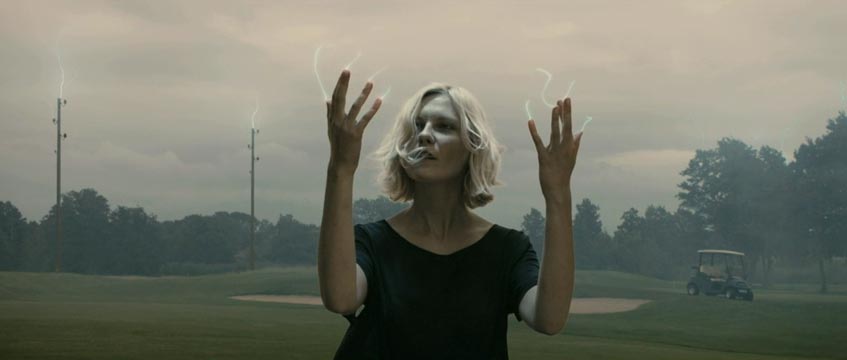
For those of you not familiar, Melancholia is a film by Lars von Trier, who describes it as a psychological disaster drama, wherein a rogue planet (called Melancholia, duh) is drifting through space and is supposedly going to pass gloriously and harmlessly by the Earth, but in fact rams into us head on and destroys everyone and everything including our main characters, Kirsten Dunst, her sister Charlotte Gainsbourg, and the latter's young son. It may sound like I just spoiled the ending for you, but it turns out I did not! That information is all contained within not only trailers, but the opening eight minutes of the movie. Von Trier has said that he did not intend for any suspense related to whether the Earth will be destroyed, but rather in how the characters react to the knowledge.

Spoilers and greater details regarding the rest of the film and my complex hurricane of feelings about it after the jump.

I should start off by saying that I went into this with an intense dislike of Lars von Trier. I have a lot of reasons for this, which I'm not going to go into, because that's not the point, and ultimately it doesn't impact my ability to enjoy [THIS ONE PARTICULAR EXAMPLE OF] his work. I find that one is quite capable of deeply hating various people and begrudgingly respecting them at the same time (Quentin Tarantino, Roman Polanski, Ron Burgundy), and since those are really two different conversations, I am not going to defend or explain my feelings about Mr. von Trier right now.

Those feelings did, however, keep me from seeing Melancholia in the theaters, which is a bit of a shame, because damn if this is not a movie that should be seen as on big a screen as possible. But I watched it on Netflix, about a week ago, and I have been in recovery ever since.

Melancholia is part of a current trend toward End Of The World movies. Has anyone else noticed this? In addition to Melancholia there's been Contagiona thing with Eva Green and Ewan McGregor which looks like it is just full of emotional whiplash, and an upcoming similar thing with Steve Carell and Keira Knightley. More recently there was ALSO Another Earth, which is not about the end of the world at all, but IS about a mysterious and unexplainable cosmic event and how it psychologically impacts its main characters, which is extremely similar to Melancholia. (Though quite different in scope, focus and budget, Another Earth is also mightily worth seeing.)

This is not to say that we've never made end-of-the-world movies before, certainly we have. But I'm starting to sense a change in direction. Lately filmmakers seem to be trying to go hyperrealistic with it, or to focus less on the destruction and the action elements that are traditionally paired with such movies, and focusing more on the psychological effects, the human stories at the core. Which is good and more interesting to me! But it also annoys me for an incredibly petty reason, which I'll tell you briefly even though it is off topic: before all of this started, I had a vivid dream wherein I knew the world was coming to end through some unstoppable cosmic event, and we had known it was coming for a number of years, and this was the last day. Waking up was an intense relief that I have never quite felt before. All that dread and anguish my subconscious made me feel was very real, so I took the next natural step and started writing a story about it, to get those feelings on paper. I never finished the story, and within some months these movies started cropping up, and now what may have been a somewhat original idea looks like it's following a trend. This has been happening throughout my life and fuels me in my belief that I must get things done NOW NOW NOW or it will be too late because someone will unwittingly steal it from me, which in turn feeds into my obsessive perfectionism that makes everything very difficult for me. But more on that in another post, perhaps.

I'm not going to talk a whole lot about my interpretation of this movie or the artistry of it, because I think a lot of other people are probably talking about that better than I can, and what I want to talk about is in keeping with the general theme of this blog, which is about the depression, panic and fear that is depicted in this film, and also incited by it. As such you probably shouldn't look at this as a review. This is personal, a disjointed commentary on how this movie affected me.

The first eight minutes of the movie are cut off from the rest, and could almost be watched separately as a short art film. It depicts Dunst and Gainsbourg in a variety of surreal scenarios as the world comes to an end around them, all shot in super slow motion so it's sort of agonizing to watch, for more reasons than one. During this period you learn something about both of them: Dunst is grim-faced, unafraid, fascinated by what is happening around her. Gainsbourg is fucking terrified.

There's a particular shot which was used in the trailer and haunted me then, and haunts me now: Gainsbourg running (well, in the motion of running) across a golf course, carrying her son. It looks like she's screaming or crying (there is no sound in this sequence, just a relentless clip of Wagner music which recurs endlessly throughout). The thing that gets me about this shot is her footprints. They're pronounced, muddy -- it's hard to tell, but it looks like they're deeper than they should be. Is this supposed to be an effect of gravity caused by one planet hitting another? I don't understand enough about physics/astronomy to know, and I'm quite certain that von Trier didn't really research shit like that, because it wasn't important to the story (I get that, I do). In any case, her positioning is odd, there's almost an uncanny valley look and feel to this whole sequence, how abominably slowly everyone is moving, and let me tell you: it fucking terrifies me. Once you watch that sequence I sort of defy you not to watch the rest of the film, but I also understand if your reaction is "FUCK no" at that point. I sort of doubt you'll follow through -- well, unless the "fuck no" is a response to the high-artistry of it, and that kind of stuff just turns you off. I'm talking about the deep stomach-turning dread of this scenario, world ending, nowhere to run but running anyway. I feel like the slow motion is almost meant to give us a sense of helplessness -- they're not going anywhere, there's no time to do anything, this is happening. And maybe it's also meant to show us some calm (those are definitely the conflicting responses of Gainsbourg and Dunst, respectively). In any case, it's beautiful and grotesque, and at the end of it this giant planet hits our little one head-on and that's the END OF THAT. Then the movie starts.

That sequence is supposed to be viewed like the overture to an opera (of course the Wagner music is FROM the overture to Tristan and Isolde): setting up visual motifs and sort of introducing the characters and telling us the ending, so we know what's coming and we know the significance (or lack thereof) of all actions that follow. Then the movie starts.

The film is divided into two parts, each focusing on the two sisters: Justine (Dunst) and Claire (Gainsbourg). The first half is mostly about Justine's unbearably awkward wedding going horribly, quietly awry -- she becomes increasingly depressed and withdrawn, the ceremony goes hours and hours over schedule, tensions are high, etc, finally leading to Justine having sex with some stranger and her husband the vampire from True Blood calling it off just as soon as it's over. WELP. There's some stray focus on the night sky throughout this sequence, lots of fancy telescopes in the background of shots, lots of Dunst gazing up at the stars, and it's sort of maddening because the viewer knows what's coming and is forced to wait it out, instead watching this dreadful occasion fall apart. There's a lot to be said about this, but I'll leave that to someone else. I want to talk about the second half.

In the second half, Claire and her husband Kiefer Sutherland (I know, right) are receiving Justine at their estate, where the wedding took place -- so time has passed, but we haven't moved. Justine is now in a state of severe depression. The kind where you can't get into a taxi cab that's waiting for you because you're too scared to go anywhere. Where you don't get out of bed for literal days. Where you won't even take a bath, even that is too hard, even when your sister has undressed you and is trying to help you into it.

I have never had those three experiences, but holy fuck, I have been there. I know what that is. I know what it is to revert to this sort of childish state of being because you're too afraid, too ill-equipped to face your life. I know that fetal position, that limpness, that scream, that way of sort of drifting through the day. I expect that everyone who knows these things suffers the same pangs of shame and embarrassment at seeing this accurate depiction of emotional turmoil, and I know that Lars von Trier was drawing from personal experience. If you have ever been seriously depressed to the point of incapacity this is going to hit you. Even if you haven't been THAT seriously depressed, it'll hit. If you're already depressed on the day that you decide to watch this movie (as I was), it is going to drag you down further. Not least because of where it's headed.

Justine starts to recover bit by bit, and the focus shifts to Claire. Her husband (Jack? Joe? John? I don't remember, I just know I hated him) is an amateur astronomer and he is very excited about this exciting phenomenon of the planet Melancholia drifting by. Claire, a sane human, is not really excited and more obsessively googling to see if they're going to be all right. Which of course annoys unsympathetic control-freak husband Sutherland to no end. EVERYTHING WILL BE FINE, Claire. YOU JUST LISTEN TO ME, EVERYTHING WILL BE FINE.

Obviously, we know he's wrong. Everything is not fine.

I hate him, and I think you're supposed to hate him, for a few reasons. This everything-will-be-fine attitude extends to his having no patience for Justine's depression, which, fuck you, man, seriously, fuck you. He shows himself again and again to be nothing but a greedy rich husband who likes being in control of his wife, her sister, everything around him. And NATURALLY, because there is no other ending for a guy like that, when he learns he is wrong after all, and that his doom is coming and there is nothing he, even he, this control freak, can do -- he kills himself. He kills himself with pills CLAIRE BOUGHT, possibly to kill herself with. He doesn't say anything to her. He doesn't tell her the truth about what's happening. He just vanishes, leaving her to discover the truth on her own, and to find his fucking body in the stables. GOOD JOB, ASSHOLE. I mean, it's a perfect ending to his arc, but oh my god do I hate him. I hate him for not being there for Claire. Because oh my god, if Justine was me before, it's nothing compared to how much Claire is me. I can't deal with how much Claire is me. Literally, I'm not saying that like they say "I can't deal" on the internet... I actually, earnestly can't really deal with it. It upsets me. It upsets me how true her reaction to oncoming inescapable destruction feels. I am sure it's a reaction many people could expect of themselves in such an event, but that doesn't matter, if you've ever felt down on yourself you know it doesn't matter that others feel the same, are going through the same hardships. Not really. The viewing experience is personal, intentionally so. I watched it and didn't see Claire as a representation of a greater portion of humanity: I saw her as me. I am a coward. I would run. There is nowhere to run but I'd run. I'd want to attempt to do something meaningful or comforting with my last hours (as she tries to suggest, an idea brutally shot down by the now totally zen Justine), even if it's stupid and won't help. I'd cry and scream and refuse to accept it down to the last minute. Maybe that isn't true, maybe I'd react differently. But I don't think so.

I don't really like that about me.

On Wikipedia it says Lars von Trier came up with this idea after talking to a therapist about his depression -- evidently she told him that depressed people react calmly to great disaster because they already expect the worst. Makes sense, I guess. Justine reacts with total calm, even happy to know that the world is ending, that humanity is about to be snuffed out, because fuck humanity. Which is a pretty disturbing sentiment. Also disturbing is her seemingly clairvoyant assertion that they are alone in the universe and this marks the end of life AS WE KNOW IT. We're sort of given to believe that this is in fact true, that Justine has some sort of power that allows her to know things. I think Lars von Trier probably wants us to believe her. I don't entirely know why this was so important to him, that this marked not just the ending of humanity but of all life. Actually I guess I do know: because of the finality. The emptiness of the black screen that comes when the planet is finally destroyed. That is it. There is no hope. There is no reassurance. That's just it.

Afterward I called this movie the ultimate nihilist experience. It is almost masturbatory in its nihilism. And it made me angry that I had watched it. It made me angry that Lars von Trier had evoked all these fears and feelings in me, angry even while I recognized that he had done his job as the filmmaker, and that any movie that affects you that way is worth your attention. But still it made me angry. That's about me, not so much about the movie. About me desperately afraid that I'm going to die young, or that the world will end somehow, or that one day things will get so bad that I'll be too afraid to get out of bed. This movie showed me all the worst things about myself. Justine's drift into darkness that keeps her from enjoying her own wedding. Kiefer Sutherland wanting to be in control of his life to the degree that when he sees the inevitable hurtling toward him he pussies out and takes pills. I see both of those in me (that's why I hate him so much). Mostly there's Claire, though. Wanting it to be a bad dream, like the bad dream I did have, wherein I behaved more or less like I expected. I don't want to be that person, I don't want to be Claire. But I am. I'm Claire.

I guess that's sort of all I have to say, and it's abrupt, but that's kind of fitting in a post about this movie, isn't it?

Wednesday, April 11, 2012

Meditations in a Rational Moment

That last post was a doozy, and while I think I needed to get that it off my chest, I didn't like having it sit up there at the top. Time to cheer up. Time to move on.

First things first: I know a lot of people found that last post by searching the depression tag on Tumblr, which, if you've ever done that (TRIGGER WARNING), you'll know is about the most devastating thing you can do. If you've been led to this post in the same way, then I hope you read this too: I know that when things seem hopeless, it's hard for someone to make you magically feel better - there's no switch to get flipped, there's no way to just force yourself back into a happy mood. Know that these things take time, life will not always seem awful, and there's no sense in punishing yourself for what you perceive as your shortcomings. Just saying that doesn't make much of a difference, I know; but knowing it intellectually, just telling yourself that you don't deserve the sadness or the pain, even if you don't believe it at first, is an important first step. Take note of your emotional state, and don't do things to yourself or make big decisions when you're not doing well or thinking rationally. Everything seems so much worse and more apocalyptically bad when you're upset. Take it from me, in a rational moment: a good period will always turn into a bad one, and a bad period will always turn back into a good one. You gotta learn to ride the wave of your emotions, to use a slightly ridiculous but apt metaphor. And talk to people. Find people who will listen to you. Call a hotline if you don't know anyone who will listen. Get it out of you. Don't feed it into the unsatisfying echo chamber of your Tumblr. Channel it into something productive (wash the dishes, clean, go for a walk) or creative (write stories, draw pictures, make music). Or put it somewhere where you'll hear something back.

As for me, my life is moving along at a better pace already. Sometimes it takes that incredible despair to get you up out of the pits, moving again, whether to spite yourself for feeling so low, or just because ENOUGH already. That's been my experience, anyway.


So the prospect of living life is a lot closer, and that's still moderately terrifying, but as pieces fall into place I feel more or less okay about it. It's easier to move when you already have momentum, it's starting to move that is terrible. And the waiting. The long, awful period of waiting and wondering what's going to happen in my life. Maybe that feeling never fully goes away. Maybe it's something you just have to live with. Sometimes you have to live with your sadness. And that's okay.

Today's Rilke reading is wonderfully apt. From Letters to a Young Poet, which is required reading for every aspiring writer/artist:

It seems to me that all our sadnesses are moments of tension that we
feel as paralysis because we can no longer experience our banished
feelings. Because we are alone with the unfamiliar presence that has
entered us, because we feel momentarily abandoned by what we've
believed and grown accustomed to; because we can't keep standing
as the ground shifts under our feet. That is why the sadness passes
over like a wave. The new presence inside us, that which has come to
us, has entered our heart, has found its way to its innermost chamber,
and is no longer even there—it is already in our blood. And we don't
know what it was. We could easily be persuaded that nothing
happened, and yet something has changed inside us, as a house changes
when a guest comes into it. We cannot say who has entered, we may
never know, but there are many indications that the future enters us
in just this way, to transform itself within us long before it happens.
That is why it is so important to be alone and attentive when you are
sad: because the seemingly uneventful and motionless moment when
our future steps into us is so much closer to life than any loud and
accidental point of time which occurs, as it were, from the outside.

Saturday, April 7, 2012

Deprecation

When you were a kid you were going to be somebody. A household name, a world-changer, a paradigm shifter. Big deal. Kids think this of themselves. Kids of your demographic are raised to believe they have it all and can be anything they want. Everyone has heard the same tired arguments that children should not be raised to believe they are special, should not be sheltered to the point of grand disillusion when they get out there in the horrible world, but that doesn't really matter to you right now. Those arguments are systemic and do not reflect your individual situation. Your parents did not spoil you, did their best to prepare you, which is all any parents can ever do. They encouraged you to get a job, and when that did not work, when reason failed, they begged you or fought with you. No small successes made much of a difference in the long run, and that is okay. You know that is okay and you've come to terms with it. You were a kid; you had no idea it would be this rough.

When you were in college you were going to be somebody. You were on your damn way. Making movies, writing stories, surrounded by the like-minded, the strong-willed, the ambitious and the clever. It was never a paradise but you loved it, even on sad days you berated yourself for wasting your incredible good fortune on being sad, and in moments of great happiness you took care to look at your surroundings, to reflect on yourself, to remind yourself that very soon this will all be gone, and you made sure to remember. You have these moments logged away, collecting dust, already hazy, so little time later.

You were a force to be reckoned with there, a small reputation gathered among your peers and certain of your professors for being wildly engaged and perhaps psychotically productive (while others noted that your work for their classes was slipping gradually to the wayside; but those classes did not matter, they were filled time, necessary credits, bare essentials of academic life, small concerns because you were making things). When it came time to leave, you were ready for it to be over (they always are) and you had plans - nothing concrete, mind - to continue on this path to greatness and glory, no matter what it took, no matter where you were. Your mentor advised you not to go back home, to stay here, in the city, where everything was happening, but you could not do this, for personal reasons and practical ones. This too is okay. You did nothing wrong. You had no idea it would be this rough.

For three months and then for one year you lived with friends and then with family, happy and unhappy, busy and not. After five months you got a job. After two months they fired you: you did not work hard enough, did not excel quickly enough. They fired you right before Christmas, just after you finished your shopping, after you decided to spend more than usual on your family because hell, they deserve it, and look at you, actually making money! Mistakes were made; but you couldn't have known they'd fire you. Fuck them, anyway. It was a restaurant. You do not belong in restaurants, with your weak limbs and your quickly-tiring feet and your soft voice and your awkward, easily overwhelmed nature. It does not matter. You will find something else. Hell, you will start that novel you always wanted to start. You can put it online to share with anyone who will read it, to keep things moving, to get into a rhythm. You're going places. Some days you have to struggle to persist, and sometimes you let it all slide away. At the back of your mind you know you've got to take the rest of your life off hold; but you'll be fine. Someday you'll figure it out; someday you'll know. Something is bound to turn up.

And then gradually you realize that you don't want the same things you did a year ago; you don't know where you want to live or what you want to be doing, and, aghast, you mourn for the loss of that kid, that student, that wild thing who could be anything she wanted. What has happened to you? You've become thick and lazy and bent out of shape. When those rare occasions do come for you to make things again, you barely remember how; it is something like riding a bike, but just as you always were with bikes, you are clumsy, you forget how to operate your camera, must relearn all your tricks. You realize, with a slow onset of deep internal fear, that you are getting worse, bit by bit, that if this continues you may lose yourself entirely. Your friends barely think of you anymore, and why should they? They are far away, living lives no easier than yours, but perhaps more active, more surrounded by others, even if they do not realize it and do not take advantage of that fact. Occasionally you visit them, but it grows harder every time, and more and more you find reasons to back out of it: lack of money, lack of incentive, lack of floors to sleep on. This is becoming a habit for you, isn't it? This "who are you kidding" mentality. You're not qualified for that job. You don't have the money for that visit. You aren't good enough to write that story.

And it's almost two years now, almost two whole years, and who are you? What happened to that kid, that student, that wild thing? What have you got to show for yourself? A thousand unfinished projects and that novel, still going strong, it has its ups and downs and no one is paying you and hardly anyone is reading it, but that doesn't matter because you're doing something, right? At least you're doing something. Your first desperate plans to get the hell out have folded, and now you have more, another destination, another strategy. It's better this time; you're making the right decisions, forcing yourself to apply to more jobs, forcing yourself to walk the dog on occasion, forcing yourself to do things, see people, ask for help when you need it. It's okay to eat: your parents can afford to buy food for you, they don't mind doing it, they don't want you to starve. It's okay to have dark days, and days where you do nothing but lie on the couch watching TV on your computer, all those shows you always meant to watch. Look at you, rereading the books you loved when you were a kid, maybe to remember those times a little better - you've never been a good reader, and look at you reading! But you realize as you sit on this couch at 3pm in your pajamas, sweating under this blanket and turning the pages of Madeleine L'Engle's A Wind in the Door, still so good as it was in 1995, that reading is just like watching TV, just another time waster, another excuse to lie around and wait for the future to happen. And you lay the book aside and you apply for a couple of jobs on a couple of sites, and one of them sends you some helpful data about your competing applicants: shows you their average years of experience, their average distance from this job that you have applied for in a different state. And you realize as you sit on this couch at 4pm in your pajamas, stomach hungry for lunch, dog needing a walk, still sweating under this blanket, that you aren't that girl anymore, that person you described in the first few paragraphs.

What you are is weak and useless, you with your worthless degree, your pathetic lack of real world experience, your nonexistent bank account (closed long ago for lack of purpose), your homelessness, joblessness, your lonely life in your parents houses with so few remaining friends and your girlfriend far away. You put on sad music (Ben Folds' Still Fighting It, Guster's Come Downstairs And Say Hello) and examine your tendency toward melodramatic bouts of ennui, your childish regression each time the world seems too hard, too scary to be handled. Little baby, crying and wanting someone to make it better, too afraid to deal with it yourself. Whining about how hard your life is, poor you, you lucky fucker, pretty, healthy middle-class white girl with supportive parents and loving girlfriend. The audacity, you sneer, how dare you describe your life as "rough," how dare you wax poetic on something so abysmally mediocre, when there are children starving and dying all over the world? Just because you can't get off your ass and find a job? Pull yourself together, you pathetic little shit. But why would anyone hire you? Why would they want you, so lazy and dreamy and emotionally unstable? Even if you made it somewhere, would you last? Would they reject you again, as others have, for your "lack of work ethic," your "lack of initiative", and would you believe them, as you did the others? Would they be cruel, implying that you are not good enough for them, as others have, others that you still blame for making you feel this way, as petty as that is? Would you let them break you - or worse, enfold you? Would you forget yourself entirely, lose every bit of that kid who dreamed about winning Oscars instead of doing her homework like she was supposed to, and become some feckless machine drifting out of the prime of her life with a million ideas and nothing finished?

It's 4:57pm. You wipe your face dry again and perfunctorily tap out some nonsense with numbing fingers. When it's over you'll put some clothes on and take the dog out and treat yourself to a bath and have a healthy late lunch of salad and hummus (this will justify you in ordering Chinese food later on your parents' dime). You look at what you've written, the horrible things you say to yourself, and wonder if you should post it, if people will think you're crazy, if people will try to make you feel better by telling you "but you're so talented!" You'll post it because this is one thing that doesn't scare you: this is who you are, this is what you deal with every day. It's horrible and it's painful, and you want to learn how to stop. You'll learn. Putting it down always helps, releases it into the ether, out of your system. Cleansed for the time being, you think you're ready to face the evening with composure. Things aren't so terrible. You'll be okay. You'll be okay.

Saturday, January 14, 2012

South Side of the Sky (a fragment)


Part of something larger which may or may not ever come to fruition. Written with this song in mind.


“You can feel it, can’t you?” The old man’s voice was the brush of a butterfly’s wings in that thunderous storm, barely audible, but somehow distinct and capable of great power. “The ship is part of you now. She’s in you; in your bones, in your blood.”

I could feel it, all right. Or rather I could feel everything that was happening to it. The whirl of elements outside buffeted the airship as though it were no more than a butterfly itself, wind with such velocity and vigor as would surely kill a man, rip through him like paper. We were in the upper heavens now, in the relentless void of the mountain range, where the weather was as cruel as it could be. I could feel it so acutely it was as though it were beating against my naked skin. I felt the tremendous cold and the simultaneous warmth as my blood rushed in to save me. My nerves were all fraught with confusion—I was suffering no actual damage, but my entire body was responding as though I was. I was in pain. I was terrified. My grip loosened a little.

“Don’t let go.” Pilot could see what was happening to me, even as subtle as it must have been. Immediately I felt a little surge of resolve—small, but significant. He had that effect on people. His voice was very soothing. It was what made him such a good teacher. “The ship will protect you. Think of her as your armor. Your exoskeleton. She has survived far worse than this, and she will take care of you, so long as you take care of her. You must guide her. Do not fear for your own structural integrity, or hers. You are focusing outwardly, on the storm and the world around you. Your attention is not with the ship, where it needs to be. Focus on her presence within you.” A little smile in his voice. “And don’t forget to breathe.”

In, out. I could feel the tingle in my blood, the faint ache in my bones. It was exhausting, flying a ship like this. I could see why no one wanted to do it anymore, why it had the terrible reputation of driving men to both mental and physical dystrophy. I could see why Pilot had retired, and also how he had such great vitality, even at his age. I suspected he was far stronger, at sixty-three, than I was now, in the prime of my life.

“I feel her,” I murmured, already gasping. “She’s being pulled apart.”

“She will be fine.” Pilot’s old hands were on my arms, which had started to shake.

The shorted telecomm crackled abruptly back to life and was filled with the voice of our understandably distressed navigator.

“—can’t see a bloody thing—Wick? Wickerfield? You there, boy?”

“I’m here.” I could hardly hear my own voice. The external wind filled my ears, battered my body. My fingers felt frozen.

“By my estimates we’ve still got a bit of a buffer between us and the mountain range,” she was saying, “but it probably ain’t very much. You’re gonna have to pull us way the hell up, boy, if we want out of this in one piece.”

“Do you have coordinates?”

“I got nothing. I am completely blind. This bloody storm’s knocked out just about everything I have.”

“We’ll be all right, Ofelia,” said Pilot, his voice clear and steady. “Sit tight and tell everyone to buckle down. And I mean that literally. Things are going to get wild before they get smooth again.”

Pilot cut the communication out before Ofelia could say anything more, and he said to me, “Move forward.”

“Ofelia said—”

“Ofelia is a blind navigator,” said Pilot. “She is in a panic because she does not have your advantage: she cannot feel what is happening. Go in deeper. Listen to what she’s telling you. Be calm and trust her. You’re a smart boy, and she’s an old, powerful machine. Together you can take us through.”

I closed my eyes, but my breath was coming in short, fluttering fragments. I felt fatigued, pulled apart. “I can’t do this,” I gasped. “I can’t do this.”

“You can.” Pilot tightened his grip on my arms, fortifying me gently. “You can.” Then he let me go.

I felt the sting of the cold. The rush of air. The hard knife-slices of snow and ice. But we could push, she and I. Pilot was right, this ship was old and strong. She was stubborn. I nudged her forward, and she was rocked with such force that I felt like my back was breaking.

“Don’t go gentle,” Pilot murmured. “Be aggressive. There’s no time to waste.”

We pushed forward harder, and I suddenly felt all the wind knocked from my lungs in a sudden, violent burst of clarity. The turbulence was astounding, and I am sure Ofelia called down again to unleash a stream of profanity, but I didn’t hear it, didn’t feel any of it. We rode the chaos with exhilaration and ease. We broke through it even as the storm pulled us in a thousand directions, trying to shatter us. We were too fast. We pushed ourselves headfirst into the onslaught and used its momentum to fire ourselves forward.

And then we were out. In the little center of calm. I felt a sudden, exhausting flood of warmth fill my throbbing, strained limbs. I felt like I was dying.

Ofelia’s disembodied voice joined us again. “Pilot? Wick? You boys still alive?”

“Very much so,” said Pilot. I could hear him smiling.

“Well that was absolutely mad, but we made it into the eye. I can see the mountains below us, and they are scary-close. Now can we  pull up?”

“Right you are,” said Pilot, and he helped me pull down as hard as I could, hauling the full weight of that monstrous beautiful craft upward. I could feel my own center of gravity shifting, pulling at my insides. When we were aimed at the clear, distant sky, I kicked the ship forward and we shot up to easily that I almost passed out right then and there.

We broke out above the clouds, where everything was still.

“Better take over from here, love,” said Pilot to Ofelia. “Mr. Wickerfield needs a bit of a rest.”

“Roger that,” said Ofelia. “Good work, little ‘un.”

I couldn’t reply. Pilot unlocked the mechanisms from my arms and my legs and helped me drop down to my knees. He stroked my hair briefly, a kind, grandfatherly sort of gesture. My emotions were all over the place.

“Told you so,” he said.

I had just enough energy for a smirk, even though he couldn’t see it.

Tuesday, December 20, 2011

I Am He You Are He You Are Me


This was written for a friend, who prompted me with the words "boys in lipstick, a threesome, superstitions, albino crows, bootblacking" and with the most excellent pick-up line ever courtesy of e e cummings:

listen: there's a hell
of a good universe next door; let's go

I don't know how well I answered the prompt, but I ended up with something more than a little strange. I feel like it's teetering on the precipice of being something bigger and less disjointed, but I think it's best to let it sit. I didn't have a great deal of control over this narrator.

So here it is, as is: a chaotic fragment.


“Listen,” he said. “Listen.”

You weren’t listening.

“The fuck is an albino crow?” you persisted.

What a pair: the pea and the pomegranate seed. You’re so natural, so green behind the ears (if that is the saying I want), a little hint of overturned earth. You came right off the farm and you’d break a man’s nose for anything less than a full-hearted embrace of your lack of college education and your heathen temper. I like you. I’ve always liked you. You never learned but you’re always learning. I knew we were meant to be before you even threw your first punch.

The pomegranate, now; he’s something else. You’re old and young and he’s young and old, if you know what I mean. You’re a fixture, a reliable structure, been here since the dawn of time, where time is my willingness to talk about any of this. Who’s this guy? He comes in here with his tall leather boots and his pierced ears and piercing gaze, mouth full of bright red lipstick just itching to leave a bloody imprint on a napkin, or your cheek. He’s wild like the center of a storm, every muscle relaxed, coiled. He’s a predator. I had to have him. I’m not one for petty superstitions but this is twice in one lifetime, love at first sight, and doesn’t that have to mean something? I love you, aggressive, thoughtful, ignorant you, and I want him, I need him, I have to be his. He won me the moment he stepped into that place. Where were we again? Oh yeah.

“Listen,” he said.

“You listen,” you retort. “You said you worked for Albino Crow. And I’m asking, what the fuck’s an albino crow? I mean ain’t that just a dove? Cause it sounds like it’d just be a dove.”

And he smiled at you, a calm, tiger smile. “A crow is a crow, and not a dove at all,” he said. “That’d be like saying every white man is the same white man.”

“No it ain’t, it ain’t that at all.”

“In any case, the Albino Crow I’m talking about is just a record label.” He leaned forward over the table. “You like music?”

“I like music, everyone likes music,” you said, and you looked at me, maybe for help, though you’d be damned to hell and uncertain torment before you’d admit it. “You know who the fuck this is?”

I know I want to be a part of his narrative, if that’s what you mean (it isn’t).

“Listen,” he said again. “There’s a hell—”

“What kind of music?” you wanted to know.

“—of a good universe next door,” he continued. He smiled. I wanted those lips. I wanted those teeth. “Let’s go.”

The two of you are made for each other. You might not realize it yet (he, of course, realized it right away), but this is the start of a beautiful et cetera. There’s a part of you that knows, or senses, or at any rate won’t turn down an opportunity, and it’s the part of you that moves, gets up, and the rest of your body follows. You throw me a look that says “You’d better be coming.” You don’t want to be left alone with the Devil, the madman, the albino crow. You’ll want it soon enough. I just pray you’ll take me with you.

The hell of a good universe is exactly the paradox it sounds like. Everything is bright. Everything is faded. It doesn’t matter. It does.

It was an enclosure of open space. Speciously spacious. Spuriously so. If I’ve got to describe it, then that’s how. Bookshelves of buildings. Staircases leading nowhere, or maybe everywhere. Towers of stairs. Down we went, down and down, of course down. Mephisto and his pair of Fausts. Maybe one of us is Gretchen. I’ll be Gretchen. I don’t mind. Down to the valley. Into the street.

Losing grip on reality is something we’ve become very good at, you and I. It comes from the unholy marriage of your casual disregard for it all and the slow tick tick tick of the bomb of my brain. I don’t have time for it, I mean. It’s such a waste of energy, believing in the world, when there are beautiful boys in lipstick and tall, leather boots. We said so many things during that walk without speaking a single word. I felt you simmering, settling, felt him drawing you in. You know what I see in him now. I think you’re ready. What’s more, I think he waits until you’re ready.

And then, oh: a door.

“Here,” he said. And I saw the crow, I’m sure it was a crow even though it looked quite like a dove, white-feathered and red-eyed. There was this mad moment where I was certain it was him, the crow I mean. In the land of living metaphor the contradiction is king.

Look at us: what an odd contraption. He’s already done the impossible, made it through the patchwork of your defenses and the tangle of your clothes, and my attention’s elsewhere. There is something perversely beautiful, you know, about watching the two of you. It’s more than I can bear. I have to look away. I focus on the boots. I’ll be Gretchen, I’ll be the shoeshine boy. I don’t care. I don’t care.

Don’t forget me.

Monday, December 19, 2011

Killing Days with Death

Haven't written in a little while. Fell a bit behind. No matter; I intend to catch up.

Today was an interesting one. I slept past noon for no real reason, which put me in the troublesome position of having to struggle for a good mood. Ever have one of those mornings, where you overslept or you just feel groggy, and you can sense the desire to just do nothing, like you've already failed, already lost the unspoken battle against the days, the challenge to get up and make something. That turned from a question into a statement, but I guess it was rhetorical either way.

Anyway, I came dangerously close to just giving up right then and there, feeling miserable about how late I'd slept. That outcome was averted by a fortuitous twitter exchange with blogmaster Zac Little, who demanded I get up and do something so as not to waste all the precious time I have by being a member of the unemployed. I decided, in a sudden burst of energy and willpower, that I was going to make a video; not just any video, but my very first "vlog" post. I only recently made myself a youtube account for this very purpose. Vlogging is not the sort of thing I envisioned doing a few years ago, but what can I say? I'm fighting boredom and inactivity with all my might, and vlogging is comparatively easy. So here I am.

In the video, which is called Killing Days with Death, I reiterate my personal definitions of Everyday Panic and quote from Hermann Hesse's Steppenwolf, both of which I also did here, weeks ago. I also discuss excerpts of Rainer Maria Rilke's Letters to a Young Poet, as well as my Tarot card of the day:


This is Death. As I explain in the video, Death is deceptively frightening: in truth, it is a mostly positive card, referring to change and rebirth. The Archeon booklet includes "death of the ego" as one of the card's meanings. It is a card that I associate strongly with this project. I drew it as my daily card before starting this blog, and found it to be a challenge of sorts, to see if I could make a new go of things, essentially. Death of the ego meant death of my former self, I suppose. It was a powerful, enlivening message, and along with the Letters to a Young Poet, which I had also been reading at the time, it helped push me into this whole project.

Drawing it again today, I feel like it represents progress. In some ways, this is the completion of a first step. I've made the blog, the tumblr, and now I've started the vlog as well. And it brings me back to Rilke, and back to that line from Steppewolf: "The day had gone by just as days go by. I had killed it in accordance with my primitive and retiring way of life." Today, I can make the joke I didn't even think of during the making of the video. Today, I killed my day with Death.

Here's the video itself -- nearly eleven minutes of rambling. I expect they shall get shorter, or at least more entertaining.


Something I'd have liked to go into more detail about was that last line of Rilke's, "And be glad and confident." I remember distinctly that read that letter, the sixth letter, that very same day I drew Death the first time, and I came to associate the card's symbolism with that line. In keeping with Rilke's style, it is a simple but elegant and gently put piece of advice: to appreciate life and to hope for the best, essentially. I want to be glad and confident. I want to be glad and confident every day. It doesn't happen, but I have these little tools... a network of images and objects and ideas... that all relate back to it, and help me to remember, and to stay grounded.

I have always been very good at relating one thing to another, often in ways that are so quick and abstract it becomes impossible for anyone else to keep up. I can't begin to explain the mental connections I've made tying Rilke to Death to Steppenwolf and back, and tying to other people and other things as well. But I can try to tease some sense out of it. I can try.

Enough thoughts. Tomorrow I shall bring you a story. If not tomorrow, then soon.

Tuesday, December 6, 2011

Cacophony


Sometimes you want everyone to just be quiet. This world is so full of voices, nothing but voices and words and viewpoints, and none of them will ever be exactly the same. We search and we search for someone to be our equal, the long-sought doppelganger, knowing deep in our hearts this person does not exist. Why is that want so natural, when there is no existent salve? Why are we wired to hunger for something that will never be?

Sometimes the noise swells up and becomes far too much to bear. There are so many ways to speak against you, and each one has its own particular sting. Even the voices with whom you feel kinship can become too loud, and listening is too difficult, and answering too futile. When everyone is talking, the words are meaningless, and why talk at all? When everyone is talking, the silent man is the invisible king. That's what humanity is. That's what loneliness means.

With all this talking, it is difficult to hear what anyone is saying. If everyone could just be quiet, please. Just for a moment.

Wednesday, November 30, 2011

Let's Begin With A Little Explanation


"Everyday Panic" is a phrase I started using to describe my general state of being early in November 2011. Weighed down by the depression that typically accompanies a long period of unemployment and creative stagnation, I struggled to channel all that sadness and stress into writing, with limited success. The first thing I wrote within that goal was a deeply personal piece which, true to form, turned out pretty depressing. I am including an abridged, edited version of it, to better explain what I mean when I say "everyday panic."


[DISCLAIMER: This is kind of heavy and, I expect, not terribly fun to read. But I think it's important that I say it now and get it out there. I do not intend for this blog to be All About Depression. It's best to think of this as a little history.]


You know that book that opens with the line about killing the day in accordance with routine? Maybe not. It’s Hermann Hesse’s Steppenwolf, and the translation goes “The day had gone by just as days go by. I had killed it in accordance with my primitive and retiring way of life.” It's an amazing way of putting something. Leave it to a German. It’s such a visceral idea: to kill the day with monotony. I guess I could take comfort in the fact that Hermann Hesse also knew how this feels, but at the same time, Hesse will be remembered forever. I’m still in this state of post-graduate uncertainty, floundering with the rest of my generation, unemployed and unsure. Schrรถdinger’s Cat.


My days are difficult, and they are difficult in the way that Hesse describes. They are burdened by the increasing length of time it’s been since any one of them was marked by anything significant, much like those signs with the adjustable numbers, “no workplace accidents in ___ days.” Of course with those, a bigger number is preferable. With me a big number represents the ever-widening gap between the despair of now and idealism of then. I’m not in college anymore; there is nothing separating me from the reality that I don't really know what I'm doing with my life. And with nothing to distract me, there is nothing to do but think, fixedly, about that. Self-awareness is the bane of my existence. I am so good at figuring myself out that I can beat almost every therapist I’ve had to the punch. I know how to pinpoint the various sources of my grief, and there is nothing extraordinary about any of it. I am an ordinary person who suffers from ordinary post-college malaise, ordinary unemployment and ordinary writer's block. Ordinary depression, ordinary anxiety, ordinary insecurity. As anyone who suffers from these things can attest, knowing that you're not alone doesn't really make you feel better. The misery is still there, lurking. And if you're anything like me, it plants itself in the powder keg of unstable emotions until something small sets it off—going the wrong way in traffic, running a red light, almost getting into a car accident. I don’t know why panic sets in so often in the car, but the car is a terrible place to lose one’s shit. Every day I must treat myself with great delicacy and care, just to avoid falling back down into that dark hole.


The only cure for a panic attack is to get over it.

Everyday panic isn't exactly what it sounds like. It isn't panicking every day. It's a lot quieter. It's the voice in the back of your head that says "you're happy now, but it's not going to last," or "what exactly do you think you're doing?" To suffer everyday panic is to be forever on the edge of panic, tamping it down by succumbing to a dull, relentless existence. It's panicking at your own mundane routine. Becoming painfully aware of your own loss of inertia. It's sort of hard to explain, I guess, in a way that makes sense outside my head. But I am sure there are many people who know exactly what I’m talking about.


(Something I'd like to add now, which didn't occur to me at the time of writing that, is that "everyday panic" doesn't have to be negative. It can also mean staying active, making an effort to stir things up on a daily basis. The panic doesn't have to be mine; it can belong to my characters. And that's a positive thing for me. That's productivity.)

When I originally wrote that I had no intentions of showing it to anyone. But over the past several years, I've started noticing more and more how afraid I am to show people anything. Part of it is a fear of rejection and part of it is my own pathological need to be perfect, which gets me into this space where I have to edit the shit out of everything before I can show it to the world. On the one hand, my insanely high standards mean I tend to produce pretty decent work. On the other hand, no one ever sees it.

So, from out of the void I have created this blog. I don't really know what I'm going to put in it. I don't know if there will be any cohesion to it. But I haven't got anything better to do. So I am going to indulge my panic, internet. And I am going to share it with you.


Onward and upward, as they say.